How shopping in Rome is organised
Rome has no single shopping district; it has a straight line and a ring. The line is Via del Corso, 1.5 km from Piazza del Popolo to Piazza Venezia, lined with the same chains as any European high street. The ring is the grid of streets between the Corso and the Spanish Steps, where the luxury houses sit within 300 metres of each other. Outside that, each neighbourhood keeps its own shopping street, and the outlets sit 25–45 km out along the motorways. Decide what you want to buy before you decide where to go; a day covering all of it does not exist.
Opening hours in the centre are 10:00–19:30 or 20:00, seven days a week. In residential districts and for food shops expect a lunch closure from about 13:30 to 16:00 and a Sunday shutdown. Card payment is universal; contactless is standard.
Via del Corso, Via Condotti and the centre
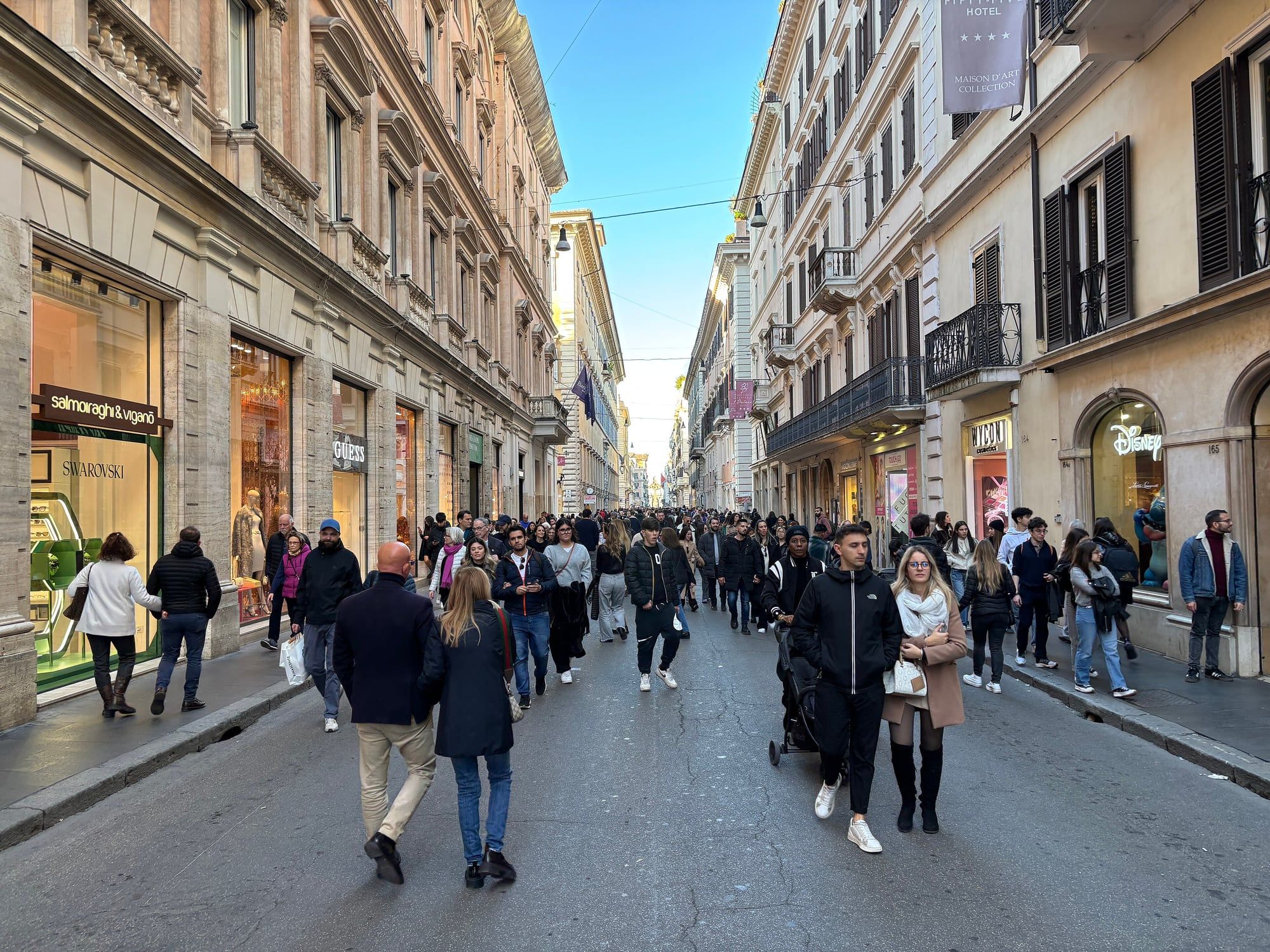
Via del Corso is where Romans shop for everyday clothes: Zara, H&M, Mango, Sephora, Nike, Italian mid-market brands and the Galleria Alberto Sordi arcade opposite Piazza Colonna. Saturday afternoon is a slow shuffle; weekday mornings are calm. The Rinascente department store on Via del Tritone, two minutes from the Trevi Fountain, is the best single stop: seven floors, a rooftop bar and a stretch of the Aqua Virgo aqueduct visible in the basement.
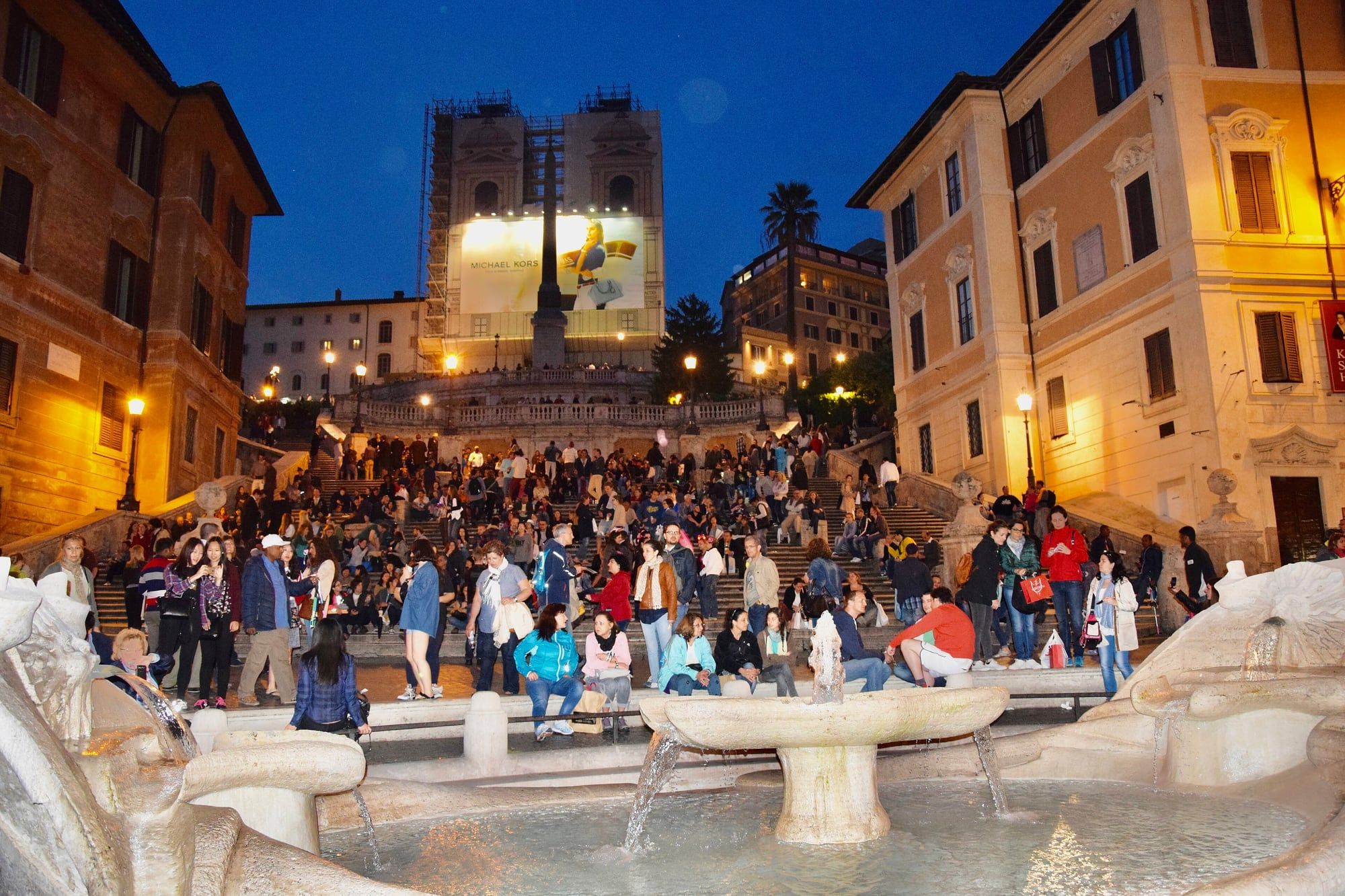
Via Condotti runs from the Corso to the Spanish Steps and holds Bulgari, Gucci, Prada, Hermès, Cartier and Louis Vuitton; the parallel Via Borgognona and Via Frattina and the cross-street Via Bocca di Leone complete the grid with Fendi, Valentino, Dolce & Gabbana and Armani. Nearby Via del Babuino mixes antiques and galleries with Chanel and Tiffany; Via Margutta behind it is artists’ studios. Expect queues at the doors of the big four houses on weekends and Chinese and American holidays; go before 11:00.
For independent shops, three streets: Via del Governo Vecchio (vintage and small designers, behind Piazza Navona), Via dei Coronari (antiques, towards Castel Sant’Angelo) and Via del Boschetto with Via Urbana in Monti (young labels, workshops, one-off pieces). Via Cola di Rienzo in Prati, a 10-minute walk from the Vatican Museums, duplicates the Corso’s chains with a fraction of the crowd and has Castroni, Rome’s best food and coffee shop, at number 196.
Castel Romano Designer Outlet
McArthurGlen’s Castel Romano outlet sits 25 km south of the centre on the Via Pontina, at Via Ponte di Piscina Cupa 64, open 10:00–20:00 every day with over 160 brands and discounts of up to 70%, according to the official site. The brand mix is premium rather than mass-market: Burberry, Versace, Valentino, Michael Kors, Polo Ralph Lauren, Nike and Adidas among them. The layout is an open-air village, so dress for the weather; there is a food court, free parking and a tax-free office.
The shuttle is the practical reason most visitors can go. Coaches leave from Via Giovanni Giolitti, on the south side of Termini station, several times a day and return at fixed times; the round trip costs €18 on Tiqets, rated 4.3 from 306 reviews at our last check, and cancels free until the day before. Note the fixed return slots when booking: four hours is enough for most people, and a full day is long. By car, take the Pontina (SS148) to the Castel Romano exit; on a weekday it is 35 minutes from the centre, on a Saturday over an hour. There is no rail link.
For a door-to-door option, minivan transfers with hotel pick-up and personal-shopper tours are listed under GetYourGuide’s shopping tours; they cost several times the shuttle and only make sense for groups of four or more.
Valmontone Outlet
Valmontone Outlet lies 45 km south-east of Rome beside the A1 motorway, next to the MagicLand theme park. It is bigger than Castel Romano with about 180 shops, the brands are more mid-range (Italian labels, sportswear, children’s clothing, homeware) and prices run lower. Opening hours are similar, 10:00–20:00.
The train is the advantage: regional trains from Termini reach Valmontone station in about 40 minutes, and a free shuttle links the station with the outlet at intervals. It is the outlet for families and for anyone who would rather not depend on a coach timetable, and it pairs with a MagicLand day for children.
Markets
- Porta Portese (Trastevere, Sunday 7:00–14:00): Rome’s flea market, a kilometre of stalls from Piazza di Porta Portese along Via Portuense. Clothes, shoes, books, bicycles, old cameras and outright junk. Go early, carry cash in a front pocket, and haggle.
- Campo de’ Fiori (Monday–Saturday, roughly 7:00–14:00): the prettiest produce market and the most touristy. Buy pasta, dried porcini and spices as gifts here; buy vegetables elsewhere.
- Mercato di Testaccio (Via Beniamino Franklin, Monday–Saturday until about 15:00): a covered market where Romans shop, with excellent lunch stalls. Combine with the Testaccio food tour circuit.
- Mercato Monti (Via Leonina, weekends): young designers, vintage and accessories in a hotel hall near Metro B Cavour.
- Via Sannio (Monday–Saturday mornings, by San Giovanni): cheap new and second-hand clothing, leather jackets, denim.
- Mercato Trionfale (Prati, Monday–Saturday): the biggest food market, next to the Vatican Museums, and the best-value place to buy pecorino and guanciale to take home.
Tax-free shopping for non-EU visitors
If you live outside the European Union, you can reclaim Italian VAT (22% on most goods, 10% on some food items) on purchases above the minimum spend in a single shop on a single day, which since 2024 has been €70. The refund arrives net of the operator’s fee, so expect 11–15% of the price back rather than 22%.
The process, at our last check:
- Show your passport at the till and ask for the tax-free form; Global Blue, Planet and Tax Refund are the common operators, and the shop must be enrolled.
- Keep the goods unused and in your carry-on luggage if possible; customs may ask to see them.
- At the airport, before check-in, validate the form electronically at the OTELLO kiosk or customs desk (Fiumicino Terminal 3 and Terminal 1). Forms must be validated within three months of purchase and before you leave the EU, so if Rome is followed by Paris, validate in Paris.
- Collect the refund in cash at the operator’s desk or have it paid to a card, which takes a few weeks.
Allow an extra 45 minutes at Fiumicino for the customs step in summer; the queue at the refund desks is often longer than at security.
Timing is everything
- Weekday mornings for Via Condotti and the Corso; Saturday afternoon is the worst two hours of the week.
- Weekdays for both outlets; Saturday crowds and the Pontina traffic roughly double the day.
- Sales: winter saldi from the first days of January, summer saldi from early July. The first weekend is chaos; the second week has most sizes and 30–40% off; the final week hits 50–70% with gaps.
- Sunday for Porta Portese only; the produce markets are closed.
- August: many independent shops close for two to three weeks around Ferragosto; chains and outlets stay open.
How to save
- Outlet discounts stack with the saldi and with tax-free refunds; a January weekday at Castel Romano is the cheapest designer shopping in Lazio.
- Ask for the outlet’s Fashion Passport or equivalent visitor discount card at the information desk; it adds 10% at participating stores.
- Buy food gifts at Castroni or the Trionfale market rather than at Campo de’ Fiori or the airport.
- The €18 Tiqets shuttle is a fraction of a taxi (about €50–€60 each way) and half the price of most transfer tours per person.
- Leave shopping bags at luggage storage near Termini rather than carrying them through the Forum.
Who it suits and who should skip it
Book the outlet shuttle if designer labels at 30–70% off are worth half a day of your trip, and skip it if you have fewer than four days: the outlet is a mall in a field, and Rome is outside. Walk the Corso and Condotti as part of a day around the Spanish Steps rather than as an outing; the streets are the sight. Markets suit people who like markets, and Porta Portese is the one worth a detour. See neighbourhoods for which district each shopping street belongs to.
Booking checklist
- Book the outlet shuttle a day or two ahead and note the return time you have chosen.
- Carry your passport for tax-free forms; a photo of it is not accepted at most tills.
- Check for shop closures around Ferragosto (15 August) and on 1 May, 25–26 December and 1 January.
- Bring a foldable bag; Italian shops charge for carrier bags and outlets are far from the coach stop.
- Keep all receipts with their tax-free forms in one envelope for the airport.
- Allow 45 extra minutes at Fiumicino for customs validation if you are claiming refunds.
Shopping in Rome works best when it is planned like sightseeing: one morning for the Corso and Condotti, one half day for an outlet if the budget justifies it, and a Sunday hour at Porta Portese. Book the Castel Romano shuttle for the outlet, and use the transport guide for the trains to Valmontone.