What a Stadio Olimpico ticket gets you
There are two products and they do not overlap: a tour of the empty stadium, or a seat at a match. Nobody sells a tour on match day.
The stadium tour
The stadium belongs to the Italian state through Sport e Salute, not to either club, so the tour is neutral: both Roma and Lazio get their story told. At our last check the guided tour is from €50 on Tiqets (checked , rated 4.4 from about 120 reviews, about 90 minutes, in English, Italian, French or Spanish, with free cancellation up to 48 hours before. It covers:
- The Foro Italico approach: the 17-m Mussolini obelisk, the mosaic avenue and the story of the 1930s complex
- The players’ gate, the tunnel and the home and away locker rooms
- The pitchside walk and the dugouts (the pitch itself is off limits)
- The press room, the trophy displays and a section on the 1960 Olympics and the 1990 World Cup
A second product, the Olympic Stadium & Foro Italico walking tour from €49, spends longer outside: the Stadio dei Marmi with its 60 marble athletes, the Fascist-era inscriptions and mosaics, the Casa delle Armi, then the stadium. Choose this one if the architecture interests you more than the football; the Foro Italico is the most complete Fascist-era sports complex in Italy, and the guides address that history directly rather than skipping it. A cheaper self-guided entry with audio guide (about €27) appears in the catalogue but was unavailable at the time of checking.
The match
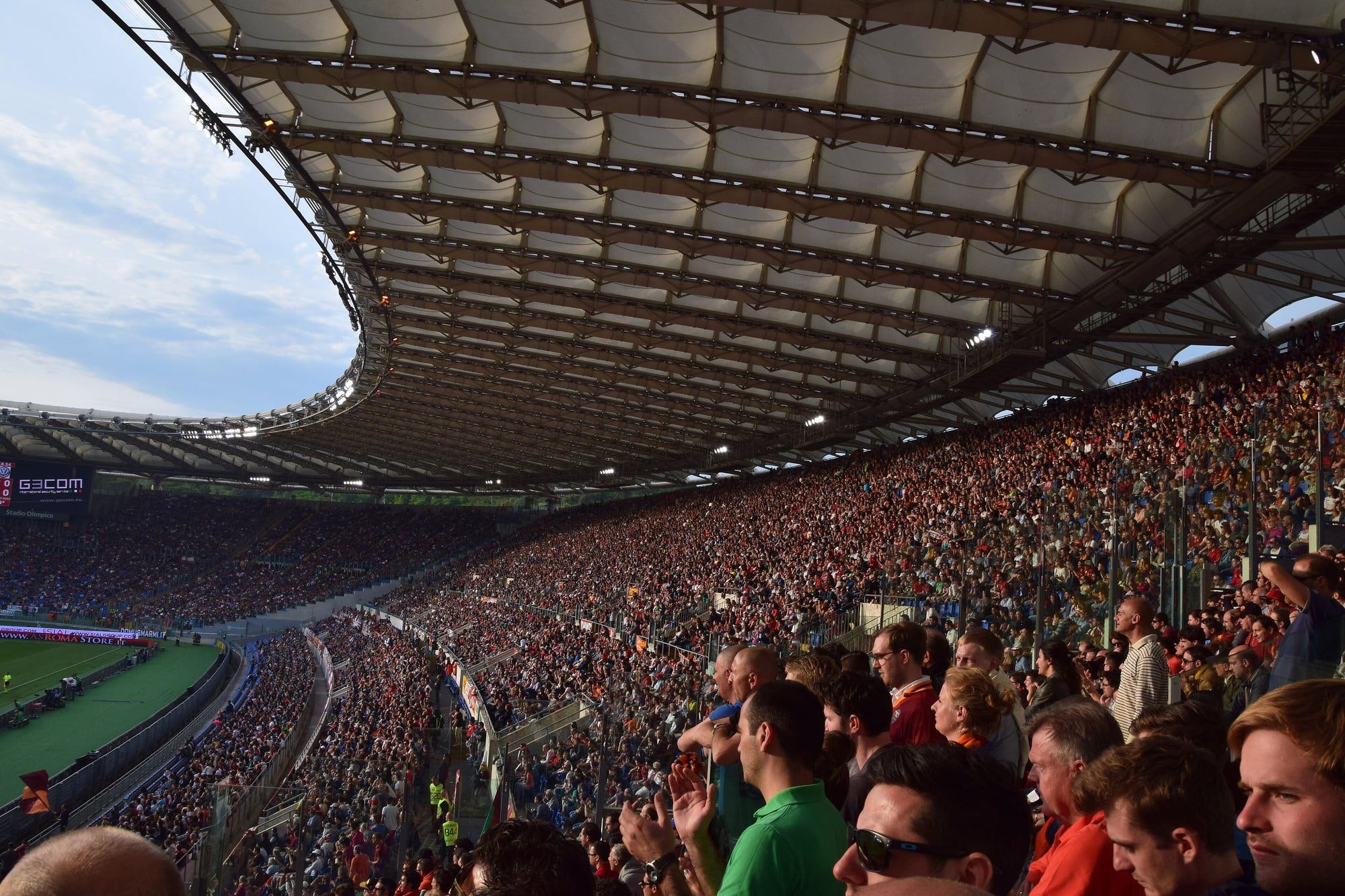
Stadio Olimpico holds about 70,600 and hosts every AS Roma and SS Lazio home game, the Coppa Italia final, and Italy’s Six Nations rugby matches. Official tickets are sold by the clubs through Vivaticket (Roma) and Ticketone (Lazio), with a members-first window and general sale a week or two before kick-off; ordinary Serie A matches start around €25–35 in the curve and €60–100+ in the main stands. Derbies, Juventus, Inter, Milan and European nights sell out to members and residents, which is where the resale-style products come in: AS Roma match tickets are from €266 on Tiqets with a numbered seat, rated 4.8 from a handful of reviews, non-refundable. That is a marketplace price for certainty, not a discount; if you can navigate the official sale, do.
Timing is everything
- Tours run on most non-match days, typically mid-morning to mid-afternoon; the calendar disappears around fixtures, concerts (the stadium hosts the big summer shows) and pitch maintenance in June. Book two or three days ahead for English.
- Match choice. A midweek Coppa Italia game or a match against a mid-table side gives you the stadium at a third of the price and half the crowd. The Derby della Capitale is the loudest night in Italian football and the hardest ticket; do not build a trip around it unless you already hold one.
- Kick-off times are fixed only a few weeks out; keep the evening flexible. Sunday 20:45 games end after 22:30 with the tram queue to match.
- Arrive early. Turnstiles open about two hours before; ID checks and bag searches slow the last 45 minutes. Aim to be seated 40 minutes before kick-off.
- Light for photos. The Foro Italico mosaics and the Stadio dei Marmi photograph best in the first hours of morning, before the tour groups.
The insider entry
Match day has no shortcut for spectators, but three things save time. Enter by the gate printed on your ticket only: the stadium is ringed by fences and moving between sectors is impossible once inside. Use the Ponte Duca d’Aosta approach from the tram (north side) for the Curva Nord and Tribuna Tevere, and the Lungotevere/Viale delle Olimpiadi approach for the Curva Sud and Monte Mario; guessing wrong adds a 20-minute walk around the perimeter. Bags larger than A4, bottles with caps, flares and professional cameras are refused; there is no cloakroom.
For tours, the meeting point is the Foro Italico obelisk or the tour desk near Gate/Ingresso Monte Mario; the confirmation email says which. Arrive 15 minutes early because groups leave on time and the site is large.
How to save
- Buy official for the match whenever the general sale is open to non-members: it is a fraction of marketplace prices. A club membership for the season is cheap and unlocks earlier windows if you attend two or more games.
- Children and under-16s pay reduced prices in most sectors on official sales; the Tiqets match product is adult-priced.
- Tour reductions for children exist at the tour desk; on Tiqets the tour is one price with children under 5 free.
- Foro Italico is free. The obelisk, the mosaic avenue and the Stadio dei Marmi can be walked at any time without a ticket; only the stadium interior costs money.
- No city pass covers it. Roma Pass and Omnia are museum passes; see City passes.
- Rugby in February and March is cheaper and easier than football and fills the same stadium; Six Nations tickets go on general sale months ahead through the Italian federation, and the crowd is mixed and family-friendly.
- Concert nights are sold by the promoters, not the stadium; a summer show is another way to see the interior for the price of a gig ticket.
How to get there
The stadium is at the Foro Italico, north-west of the centre below Monte Mario, about 4 km from Piazza del Popolo.
- Tram 2 from Piazzale Flaminio (Metro A Flaminio) to the Piazza Mancini terminus, then walk across Ponte Duca d’Aosta, about 10 minutes. This is the standard route and the one ATAC reinforces on match days.
- Bus 32 from Piazza Risorgimento and Metro A Ottaviano along Viale Angelico to Piazzale Clodio and the stadium; bus 280 from Piazza Cavour / Lepanto along the Lungotevere to Lungotevere Maresciallo Diaz; bus 910 from Termini to Piazza Mancini.
- Taxi from the centre, 15–20 minutes and about €15–20 off-peak; impossible to find leaving a match, so walk to Piazza Mancini or Piazzale Clodio first.
- On foot from Piazza del Popolo, 45 minutes along Via Flaminia and the river; pleasant before a rugby match, less so at night.
Fares, the tap-and-go system and night buses are in Transport & transfers.
What is nearby
- Monte Mario, the hill above the stadium, has the best free panorama on this side of Rome from the Zodiaco terrace, 20 minutes’ walk up.
- Ponte Milvio, 10 minutes north, is where Constantine won in 312 and where Romans go for aperitivo; combine with an evening kick-off. See Nightlife.
- The Gladiator School is the other sporting-history activity in Rome, on the opposite side of the city.
- Concerts at the stadium and the summer festival calendar are on Shows & concerts.
Booking checklist
- Tour: pick a non-match day, book on Tiqets, note the meeting point in the confirmation.
- Match: enter the exact name of each ticket holder as on their passport; carry that passport to the turnstile.
- Check the fixture time again the day before; Serie A moves kick-offs.
- Bag no bigger than A4, no glass, no cans, no umbrella with a point; there is no cloakroom.
- Wear neutral colours in the main stands; club colours only in the right curva.
- Cash for food: kiosks queue and cards fail when the network is busy.
- Plan the exit: tram 2 from Piazza Mancini, or walk 20 minutes towards Piazza del Popolo before hailing a taxi.
Stadio Olimpico is easy to visit on a tour and worth the effort for a match; book the tour on any free morning, buy the match ticket officially when you can and through a marketplace when you must, and give yourself an hour on tram 2 either side of kick-off.